
Transfer Pricing Services Hyderabad
BC Shetty & Co

Global Tech Companies need to comply with Indian Taxation

In the digital economy, multinational IT companies operate through complex cross-border structures—shared services, IP ownership, cloud infrastructure, and global capability centres GCCs).

At BC Shetty & Co, we specialise as transfer pricing consultants in Hyderabad, delivering expert-driven solutions for transfer pricing in Hyderabad for IT/ITES, SaaS, and tech-driven multinationals, helping them navigate Income Tax compliance with confidence and parallelly achieve tax efficiency.

tranferpricing

What is Transfer Pricing?


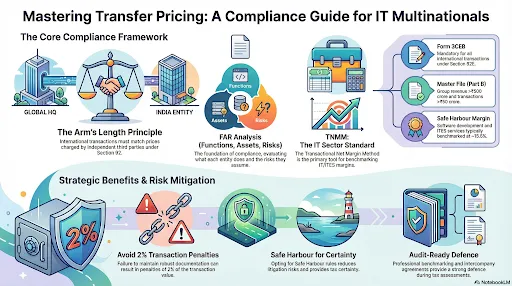
Transfer pricing refers to the pricing of transactions between associated enterprises located in different tax jurisdictions.


Section 161 of the Income-tax Act, 2025 mandates that international transactions must be computed with regard to the Arm’s Length Price (ALP).

Example (IT Company):
An Indian captive centre provides software development services to its US parent. The pricing must reflect what an independent third-party developer would charge.


How Transfer Pricing Works

Transfer pricing ensures that profits are allocated based on value creation across jurisdictions.

 
Illustration:-
India → Development centre (cost base)
US → IP ownership & contracting
Europe → Sales


The Indian entity is compensated using cost-plus (e.g., 15%), validated through benchmarking, an essential principle in transfer pricing in Hyderabad engagements for multinational IT firms.


Importance & Benefits of Transfer Pricing

Transfer pricing refers to the pricing of transactions between associated enterprises located in different tax jurisdictions.

tranferpricing

iconAvoid tax disputes and adjustments

icon Ensure compliance with Indian TP regulations

icon Prevent double taxation

icon Improve global tax efficiency

icon Strengthen audit defence

Adjustments under Section 173 can significantly increase taxable income if pricing is not at arm’s length, making expert-led transfer pricing in Hyderabad support critical for risk mitigation.

Transfer Pricing Services Offered

We deliver end-to-end transfer pricing in Hyderabad for multinational IT companies:

icon Documentation (Local File, Master File) as Transfer Pricing Study Report

icon Transfer Pricing Benchmarking studies

icon Transfer pricing clearance, Advisory & structuring

icon Transfer Pricing Compliance & filings (Form 48,56)

icon Transfer pricing Litigation & Representation support

tranferpricing

1. Transfer Pricing Documentation

  • Local File & Master File preparation
  • FAR Analysis (Functions, Assets, Risks)
  • Industry-specific IT benchmarking
  • Rule 10D of the Income-tax Rules, 2026, prescribes mandatory documentation

2. Benchmarking & Economic Analysis

  • Comparable company filtering & selection (IT/ITES sector)
  • Margin analysis (TNMM, cost-plus models)
  • Use of global databases

3. Transfer Pricing Clearance & Advisory

  • Structuring intercompany agreements
  • Pricing models for SaaS & cloud services
  • IP migration & royalty structuring

4. Compliance & Filings

  • Section 92E – Mandatory accountant’s report (Form 3CEB)
  • Section 286 – Country-by-Country Reporting in Form 3 CEAA

5. Audit & Litigation Support

  • Handling TP assessments
  • Drafting submissions & objections
  • Representation before authorities

Transfer Pricing Methods

tranferpricing
Section 165 & Rule 10AB

icon Comparable uncontrolled pricing (CUP)

icon Resale Price method (RPM)

icon Cost Plus Method

icon Transaction Net Margin Method - TNMM (most used in IT/ITES)

icon Profit Split (for IP-heavy models)

Transfer Pricing Compliance Requirements

Sections 171 & 172

Maintain documentation
File Form 48
Determine ALP annually
Maintain audit-ready records
tranferpricing

Transfer Pricing Documentation Requirements

A robust TP documentation framework is the backbone of compliance and audit defence.

Rule 123 (Income-tax Rules, 2026) mandates detailed documentation including:

Functional, Asset & Risk Analysis (FAR Analysis)

This is the core of transfer pricing. We evaluate:

  • Functions performed
  • (e.g., coding, testing, project management in IT companies)

  • Assets employed
  • (e.g., human capital, infrastructure, proprietary tools)

  • Risks assumed
  • (e.g., market risk, credit risk, IP risk)

Example:

A captive IT service provider in India performs routine development functions and assumes low risk, justifying a stable cost-plus return.

Net Operating Margin Calculation (TNMM)

For most IT companies, TNMM (Transactional Net Margin Method) is applied. We compute:

  • Operating Profit / Operating Cost (OP/OC)
  • Compare margins with comparable companies
tranferpricing

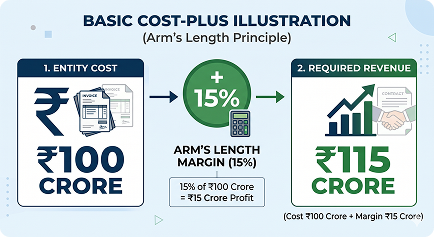
Indian entity cost = ₹100 crore

Arm’s length margin = 15%

Required revenue = ₹115 crore

If actual margin is lower → TP adjustment risk.

Benchmarking Analysis

  • Selection of comparable IT/ITES companies
  • Use of financial databases
  • Determination of arm’s length range
tranferpricing

Safe Harbour Rules (Budget 2026 Perspective)

To reduce litigation, the government prescribes minimum margins for certain categories through Safe Harbour Rules under Rule 10TD (updated via Budget 2026 alignment):

Indicative Safe Harbour Margins (IT Sector):

  • Software development services: ~15.5%
  • ITES / BPO services: ~15.5%

Benefit: If companies opt for safe harbour:

  • No detailed scrutiny
  • Certainty in tax position
  • Reduced compliance burden

Intercompany Agreements & Economic Analysis

  • Clearly defined service scope in Master service agreements
  • Pricing terms
  • Payment structure
tranferpricing

Master File & CbCR

Section 171 & Rule 123

Eligible entities must:

  • Maintain a Master File detailing global operations
  • File Form 56

This includes:

  • Global group structure
  • Intercompany financing
  • Intangible assets ownership
  • Revenue & profit allocation
Eligible Entities (Key Criteria):

An Indian entity is required to file Form 56 (Part B) if:

  • It is part of an international group, and
  • The consolidated group revenue exceeds ₹500 crore, and
  • The value of international transactions exceeds prescribed thresholds (typically ₹50 crore for transactions or ₹10 crore for intangibles)

Part A of Form 56 is required to be filed by all constituent entities of an international group, irrespective of thresholds.

Why Choose BC Shetty & Co?

images

Strong experience with multinational IT & SaaS companies

images

Deep expertise in FAR analysis & benchmarking

images

Practical insights on Safe Harbour vs Audit approach

images


Litigation-ready documentation

Frequently Asked Questions

It is pricing of transactions between related entities across borders, governed by Section 92.

Entities entering into international transactions under Section 92B, especially multinational IT companies.

As per Section 171 & Rule 123

  • FAR analysis
  • Benchmarking study
  • Financial analysis
  • Agreements
  • Form 3CEB

Sections 442 / 457

  • 2% of the transaction value for not maintaining documentation
  • ₹1,00,000 (failure to file Form 48)
  • Additional penalties for misreporting

Experts:

  • Perform accurate FAR & margin analysis
  • Ensure Safe Harbour optimisation
  • Defend during audits
  • Align TP with global strategy

Future-Proof Your Transfer Pricing Strategy

With increasing scrutiny and evolving regulations, multinational IT companies need more than compliance, they need strategy.

Partner with BC Shetty & Co for Reliable
Transfer Pricing in Hyderabad.

Let’s build a compliant, efficient, and audit-ready global structure.

×

Feel free to contact us

Let us know what you need here, we are there to help you

×

Feel free to send me your query

i normally respond within a couple of hours

CA Ankith C Shetty
Partner